Germany’s used car market is dynamic and fragmented. Prices move quickly as supply shifts, new vehicle technologies enter the fleet, and consumer preferences evolve across segments.
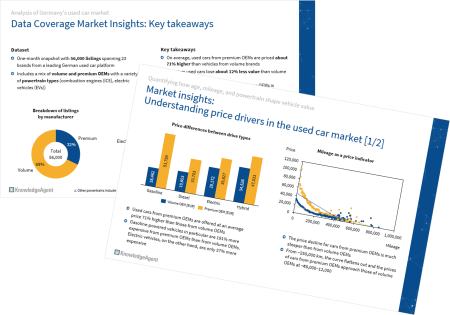
This analysis uses online offer prices from 56,000 listings to quantify how brand positioning, powertrain, age, and mileage shape used car prices in Germany. The findings highlight where premium brands sustain pricing power, where EVs compress traditional price gaps, and how residual value patterns can inform pricing, remarketing, and portfolio decisions.
Key findings (at a glance)
- Used cars from premium OEMs are ~71% more expensive than vehicles from volume brands
- Premium used cars lose around 12% less value over time than volume vehicles
- The price gap between premium and volume OEMs is significantly greater for ICEs than for EVs
The dataset: 56,000 listings as a market snapshot
This analysis is based on a dataset of 56,000 listings spanning 23 brands from a leading German used car platform. The dataset includes both private and dealer listings and covers a mix of volume and premium OEMs, across multiple powertrain types including internal combustion engines (ICE) and electric vehicles (EV).
The data reflects a one-month snapshot in 2025 and was analyzed along key dimensions including powertrain type, mileage, vehicle age, and vehicle category. While listings data does not represent transaction prices, it provides a robust basis to quantify relative positioning, price corridors, and the drivers that shape the German used car market.
If you are interested in the full analysis, download our Germany used car price analysis report and request a meeting with our team to explore a solution tailored to your questions.
Premium vs. volume: how big is the price gap?
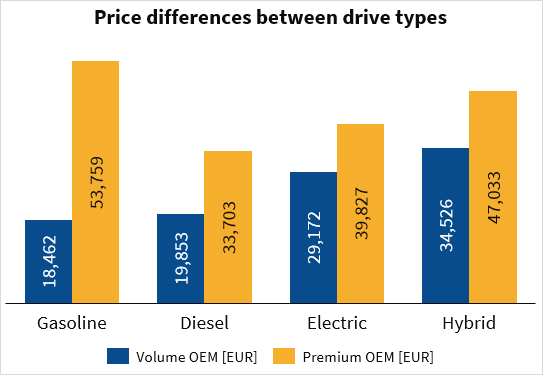
A central finding of the analysis is the clear price gap between premium and volume manufacturers. On average, used cars from premium OEMs are priced about 71% higher than vehicles from volume brands. The gap is particularly pronounced for gasoline vehicles, where premium models can be almost three times as expensive as comparable volume models.
For electric vehicles, by contrast, the premium uplift is much smaller, at just under 40%. This suggests that electrification is reshaping traditional price ladders, with brand premium playing a different role depending on powertrain and segment.
Residual value patterns: the impact of age and mileage
Age and mileage remain the traditional value drivers in the used car business, but they do not affect all brands equally. Our analysis of residual value curves shows clear differences between premium and volume vehicles:
- In the first 10 years, premium used cars lose about 12% less value than volume vehicles.
- After about 15 years, the value loss of volume vehicles largely levels off.
- When vehicles reach high mileage (around 250,000 km and above), the price curves converge: premium and volume vehicles move into a relatively narrow band.
Taken together, these patterns indicate that premium vehicles start at a clearly higher price level and depreciate more steeply at first but stabilize earlier. Volume vehicles, on the other hand, follow a more linear decline over a longer period.
EV vs. ICE: electrification reshapes price structures
Electrification is not just introducing new models; it is also changing the logic of price positioning in the used car market. Our comparison of ICE and EV segments highlights several shifts:
- The price gap between premium and volume OEMs is significantly larger for ICEs than for EVs.
- In the small car segment, premium and volume electric vehicles are converging, and prices are often very close to each other.
- In larger segments such as SUVs, premium EVs still dominate the upper price ranges, while some volume-brand SUVs increasingly move into higher price bands.
This points to a market in which EV price formation can compress traditional brand-based differentiation in some segments, while keeping (or even strengthening) price stratification in others.
Turning analytical insight into continuous business value
The underlying approach is designed for continuous use. Based on similar datasets and methods, we develop tailored analytics solutions such as:
- Monthly market summaries with key indicators like available listings, average prices, and days-on-market
- Model performance trackers that monitor price trends, stock levels and market activity at brand and model level
- OEM cluster snapshots that map inventory structures by manufacturer, including model mix, vehicle age, and powertrain characteristics
These tools help our clients keep a permanent pulse on the used car market and support smarter decisions in pricing, remarketing, portfolio steering and strategic planning.
If you are interested in using market data to gain a sharper view of your position in Germany’s used car market, our team would be happy to discuss how we can support you with a solution tailored to your questions and data environment.